Key takeaways: Living in Saint-Colomban almost always means buying a single-family home, at a median price of $592,500 in the third quarter of 2026 according to Centris. At that price, the welcome tax reaches $8,385.50. The septic tank must be emptied every two years, water often comes from a well and the high school is in Saint-Jérôme.
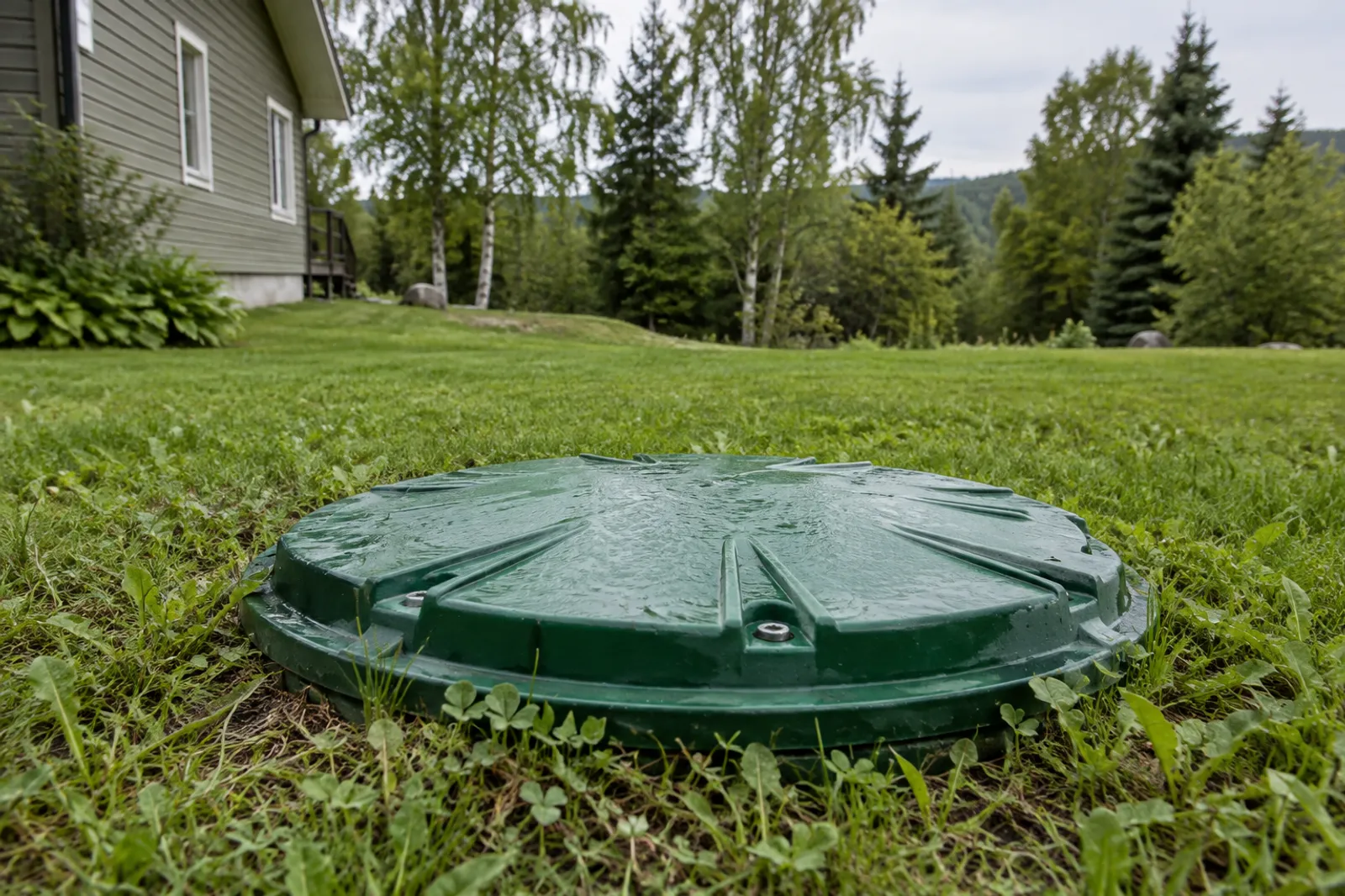
No home in Saint-Colomban is connected to a municipal sewer. Living in Saint-Colomban therefore means buying the septic tank and the leaching field along with the kitchen and the bedrooms.
That is the trade-off for a wooded lot next to Saint-Jérôme and Mirabel, with trails close by: systems the buyer alone becomes responsible for maintaining, and that should be checked before making an offer.
A market made up almost entirely of single-family homes
In short: 95% of residential sales over the last four quarters in Saint-Colomban were single-family homes, at a median price of $592,500 in the third quarter of 2026.
Centris real estate statistics for Saint-Colomban set the tone. In the third quarter of 2026, 72 of the 76 residential sales concluded in the city were single-family homes. Over the last four quarters, the proportion holds: 286 sales out of 301.
Condominiums barely exist: five sales in a year, too few to calculate a median price.
The median for single-family homes reached $592,500 in the third quarter, up 1% year over year, with an average of 37 days on the market. The single-family median in Saint-Jérôme was $547,000 in the previous quarter, as detailed in the Saint-Jérôme real estate market analysis.
House sales jumped 41% year over year, while active listings rose only 7%, to 103 properties. A well-maintained house does not stay on the market for long.
A septic tank in every home, and proof of pumping every two years
In short: no home in Saint-Colomban is connected to a municipal sewer, and the City requires proof that the tank has been emptied every two years.
The City states it in black and white on its page about septic system maintenance: every home has its own wastewater disposal and treatment system.
An owner who lives in the home year-round must send the City a pumping invoice every two years, within 30 days of the pumping. For a seasonal residence, the interval is four years.
For buyers, this obligation leaves a paper trail. Ask the seller for the pumping invoices, the year the system was installed and the permit that authorized it. Years without an invoice raise a question to settle before making an offer.
Look at the lot as well. The City advises against letting trees and shrubs grow on the leaching field, since roots damage it. A cedar hedge planted on top of it is a clue worth noting.
These elements partly escape a visual inspection: spell them out in the mandate for the pre-purchase inspection, which specifically covers properties with a well and a septic system.
Water often comes from a well the buyer should have tested
In short: outside the few areas connected to a municipal water system, the home draws its water from a private well whose quality is entirely the owner’s responsibility.
A few areas are served by small water systems managed by the City; elsewhere, the home has its own well. The address search on the municipal website shows, even before a visit, whether a property is connected to a network.
With a private well, water quality is the owner’s responsibility alone. The government page on testing drinking water from a well recommends a microbiological analysis at least twice a year, and an analysis for chemical contaminants at least once while the well is in use.
The second one, often forgotten, looks for arsenic, uranium, barium, nitrates, iron or manganese, substances that are often naturally occurring and that no odour gives away. The inspection condition is the right time to request it, since it still leaves you a way out.
To receive a selection of properties already screened for the well, the septic tank and the lot, describe your buying project and mention the cities you are comparing.
The welcome tax rises to 3% above $500,000
In short: on a house sold at the $592,500 median price, the 2026 transfer duties reach $8,385.50, a third of which comes from the bracket above $500,000.
The Saint-Colomban new resident guide publishes the 2026 brackets: 0.5% up to $62,900, 1% up to $315,000, 1.5% up to $500,000, then 3% on the portion above $500,000. For a house at the median price, the calculation works out as follows:
| Bracket of the tax base | Rate | Duties |
|---|---|---|
| First $62,900 | 0.5% | $314.50 |
| $62,900 to $315,000 | 1% | $2,521.00 |
| $315,000 to $500,000 | 1.5% | $2,775.00 |
| $500,000 to $592,500 | 3% | $2,775.00 |
| Total for $592,500 | $8,385.50 |
The $92,500 above $500,000 costs $2,775, exactly as much as the $185,000 in the previous bracket. A buyer who calculates everything at 1.5% underestimates the bill by $1,387.50.
The tax base is the higher of the price paid and the value on the property assessment roll. Add the notary, tax adjustments and the inspection, detailed in the guide to home buying costs.
Parks, trails and Laval 45 minutes away outside rush hour
In short: eleven municipal parks, two nearby regional parks that are free for residents, and Laval about 45 minutes away by car without traffic.
The City lists eleven municipal parks. Parc Phelan brings together a splash pad, a skatepark, two tennis courts and an outdoor rink. At Parc à l’Orée-des-Bois, a multi-use trail can be walked with a leashed dog, and an ice trail is added in winter.
With proof of residence, Parc régional de la Rivière-du-Nord, in Saint-Jérôme, and Parc régional éducatif Bois de Belle-Rivière, in Mirabel, are free for Saint-Colomban residents. In winter, the Golf Capri grounds open three loops of 1.8, 3 and 5 km to them for walking, cross-country skiing and snowshoeing. The City also offers a library, a day camp and Espace Libre, for 12 to 17-year-olds.
A route calculation on OpenStreetMap gives 48 km and about 45 minutes without traffic from city hall to the Montmorency metro station in Laval, via Route 158 and Highway 15. Rush hour makes it longer: time it yourself on a weekday morning.
Family life organized around the car
In short: Saint-Colomban has four elementary schools but no high school, and none has been announced.
Three points should be checked before choosing a street:
- The elementary school for the area. The four schools in the territory (des Hautbois, de la Volière, à l’Orée-des-Bois and du Triolet) are part of the Centre de services scolaire de la Rivière-du-Nord.
- The trip to high school. Public school students go to Polyvalente Saint-Jérôme or to École secondaire Émilien-Frenette, depending on their elementary school. These catchment areas shift: in January 2026, 78 spots had to be freed up at Émilien-Frenette, which takes students from des Hautbois and de l’Orée-des-Bois.
- Public transit. A regional taxibus serves fixed stops. It helps in a pinch, but does not replace a second car.
The new high school that the school service centre has been studying for the area since 2024 targets a site in Saint-Canut, which the City of Mirabel set aside in December 2025. The mayor of Saint-Colomban had said so as early as 2024: without sewer or water service, there would be no high school in his territory.

Living in Saint-Colomban knowing what you are buying
People settle here for the space and the forest. In exchange, what the City does not provide, the buyer checks before signing: the pumping invoices, the well water during the inspection condition, the welcome tax with its 3% bracket and the school commute.
Before drafting your promise to purchase, have the septic tank, the well and the comparable sales for the property you are targeting validated by booking an appointment.
FAQ
Is Saint-Colomban a good place to live for a young family?
Yes, if the family is comfortable relying on a car. Families who choose to live in Saint-Colomban find large lots, eleven municipal parks and four elementary schools, but no high school: teenagers go to Saint-Jérôme. The typical home is a single-family house with a septic tank, often on a well. For these families, the length of the morning commute matters as much as the number of bedrooms.
How much does a house cost in Saint-Colomban in 2026?
About $600,000. According to Centris, the median price of single-family homes sold in Saint-Colomban was $592,500 in the third quarter of 2026, up 1% year over year, and $618,185 over the last four quarters. Homes stayed on the market for 37 days on average. The median says nothing about the condition of a specific house or the quality of its wooded lot.
Should you have the well water tested before buying?
Yes. With a private well, water quality is entirely the owner’s responsibility, and the Government of Québec recommends a microbiological analysis twice a year and a chemical analysis at least once. The chemical analysis detects arsenic, uranium or manganese, which you cannot taste. Ask the seller for recent results, then have the water tested by an accredited laboratory during the inspection condition period.
How often must the septic tank be emptied in Saint-Colomban?
Every two years for a home occupied year-round, and every four years for a seasonal residence. The City requires it by bylaw, since no home in the territory is connected to a municipal sewer. The owner must send the City the pumping invoice within 30 days. When you buy, these invoices show whether the seller kept to the schedule, and how long the system has been in place.
Is there a high school in Saint-Colomban?
No, and none has been announced. The high school project that the Centre de services scolaire de la Rivière-du-Nord is studying for the area targets a site in Saint-Canut, in Mirabel, reserved in December 2025. Public school students attend Polyvalente Saint-Jérôme or École Émilien-Frenette, depending on their elementary school and on catchment areas the school service centre can change each year. Check the school and bus route for the address you are considering.